Nissan Qashqai e-POWER - ABC Leasing
The independent definitive Nissan Qashqai e-POWER video review
How will you view?
How will you view?
This is a sample, showing 30 seconds of each section.
POWER TO THE PEOPLE(some text hidden)
By Jonathan Crouch
Ten Second Review word count: 41
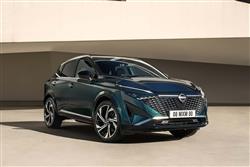
Nissan's Qashqai e-POWER offers a rather different stepping stone from combustion power to EV motoring. It's an interesting confection, always an EV yet also always petrol-powered. Who needs a hybrid? Here, we look at the re-engineered updated version of this model.
Background word count: 137
Nissan calls the Qashqai e-POWER 'an electric car that you can fill up with petrol'. That sounds like a contradiction in terms doesn't it, but this powertrain really is difficult to classify. It can't be plugged in, but unlike a full-Hybrid, the engine never directly drives the wheels, its role instead being to power a front-mounted motor. Nissan calls this 'a bridging technology' that'll help transition customers to the full-EVs they'll have to live with in the future. And this powertrain will be key to the brand in achieving its targeted 50% electrification sales mix by 2030. The Qashqai e-POWER first arrived in 2022 and continued with the facelifted version of this current Qashqai introduced in Spring 2024. Late Summer 2025 saw a re-engineering of the e-POWER package, creating the car we're going to look at here.
Driving Experience word count: 254
It's a fascinating drivetrain this - and Nissan has changed it quite a lot as part of this update. We'll start with the bits about it which haven't changed; at 2.1kWh in size, the battery is about twice the size it would be in a conventional full-Hybrid. And it's topped up by a little three cylinder Variable Compression 1.5-litre turbo petrol engine that never directly powers the wheels. Forward motion is instead taken care of by single front axle-mounted motor which (in 'Sport' mode) now puts out 201bhp (up from 188bhp before). Enough to propel the Qashqai e-POWER to 62mph from rest in 7.6s en route to 105mph. You're unlikely to much notice this increase in power, should you have been well acquainted with an earlier Qashqai e-POWER; but you might well notice the improvements in refinement that Nissan claims this re-engineered e-POWER package has brought about. The brand says that cabin noise has been reduced by up to 5.6dB. As before, and as you'd expect, the e-POWER system only works with auto transmission, but does so more smoothly than with the CVT autos used in some full-Hybrids thanks to a feature called 'linear tune' which ties engine speed to road speed. Nissan has also engineered in its 'i-Pedal' tech, which increases energy regeneration when you come off the throttle. This doesn't slow the car as much as it would with the company's LEAF and Ariya full-EVs, but it will mean that in normal motoring, you'll be using the brake pedal a lot less.
Pictures (High res disabled)
.jpg)
.jpg)
.jpg)
.jpg)
.jpg)
.jpg)
.jpg)
.jpg)
.jpg)
.jpg)
Scoring
Category: Compact Car
| Performance | |
| Handling | |
| Comfort | |
| Space | |
| Styling | |
| Build | |
| Value | |
| Equipment | |
| Economy | 80% |
| Depreciation | 60% |
| Insurance | 60% |
| Total | 65% |
Mobile
Narrow
Narrower
Normal
Wide