
THE LEXUS UX FACTOR (some text hidden) SECTIONED_new_lexusux_2019
By Jonathan Crouch
The Lexus UX still represents Lexus in the compact part of the mid-sized premium brand SUV sector. Jonathan Crouch takes a look at the revised version
Ten Second Reviewword count: 41
One of the market's most profitable segments is that for premium-branded lower-mid-sized SUVs of the more compact sort. Lexus tries to bring something different to it in the form of this UX model. Here, we look at this car's latest updates.
Backgroundword count: 123
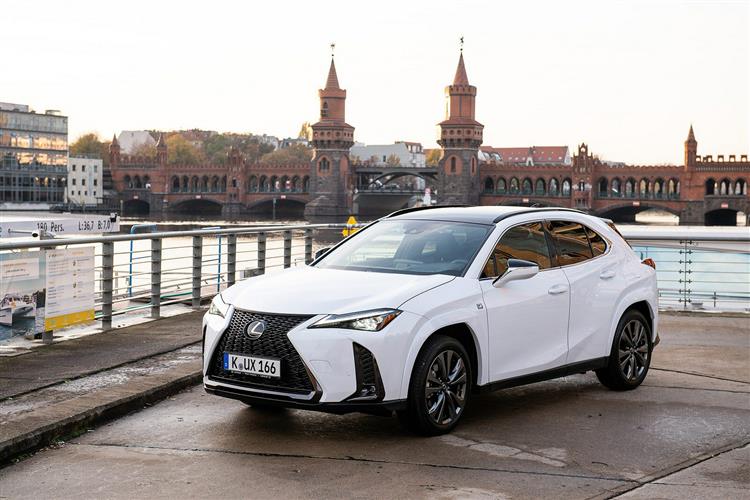
The UX was launched back in 2018 to compete directly against cars like the Volvo XC40, the Audi Q3, the BMW X1 and the Mercedes GLA. These days, it sits between the smaller LBX and the larger NX in the company's line-up. So, does the UX stand a chance against such an army of fiercely talented competitors? Well the looks are certainly a little different to what's on offer elsewhere in this sector - and so is the core powertrain, a non-Plug-in petrol/electric hybrid. There's also an alternative UX 300e battery full-electric version available if you want it. Lexus believes that over 80% of buyers will never have owned one of the company's products before. Will they like this one? Let's find out.
Driving Experienceword count: 333
You can only now get a combustion UX with front wheel drive. Power comes from the brand's usual 2.0-litre self-charging full-Hybrid petrol engine, with fourth generation Lexus Hybrid technology. So you can't plug it in but you will get exemplary fuel returns, even though this unit has to be had mated to electronic continuously variable transmission CVT auto transmission. There's 196bhp on tap, so performance is good enough to take the car to 62mph in 8.3s en route to 110mph. The 'F Sport' model gets standard Adaptive Variable Suspension too. As part of a package of 2024 updates, the steering feel was improved with a redesigned rigid joint between the top of the steering gearbox mount and the suspension member, plus shock absorber damping force was re-tuned. Lexus says that particular efforts have been made to reduce any "rubber band" effect in the operation of the hybrid system and transmission, by optimising the level of electric motor assistance and engine rpm to generate a sense of linear acceleration without the engine running at high revs. You'll still feel this issue a little though if you stab your right foot down. Handling's better than you might expect thanks to the impressively stiff GA-C global architecture platform. This model's surprisingly light for a Hybrid too, thanks to weight-saving measures in the body construction, including the use of lightweight aluminium for the side doors, wings and bonnet, as well as a resin material for the back door. The alternative version of this model is the all-electric UX 300e. This derivative gets a large 72.8kWh lithium-ion battery which powers a motor generating 201bhp, with 300Nm of almost instantly available torque which spears you away from rest like a hot hatch. 62mph from rest occupies 7.5s but top speed is limited to 100mph and you can use steering wheel paddleshifters to alter the level of braking regeneration. Driving range is much improved over the original old 54.3kWh battery model, rated 84 miles higher at up to 280 miles.
To see the full road test text contact us on 0330 0020 227
Pictures (high res disabled)
.jpg)
|
.jpg)
|
.jpg)
| |||
.jpg)
|
.jpg)
|
.jpg)
| |||
.jpg)
|
.jpg)
|
.jpg)
| |||
.jpg)
|

|
Statistics (subset of data only)
Min |
Max |
|
Price: |
£38,095.00 (At 3 Mar 2026, Premium) |
£49,495.00 (At 3 Mar 2026, Takumi) |
CO2 (g/km): |
113 |
|
Max Speed (mph): |
110 |
|
0-62 mph (s): |
8.3 |
|
Combined Mpg: |
56.4 |
|
Boot Capacity (l): |
320 |
|
Power (ps): |
196 |
|
Scoring (subset of scores)
Category: Crossover or SUV 4x4s
| Performance | |
| Handling | |
| Comfort | |
| Space | |
| Styling, Build, Value, Equipment, Depreciation, Handling, Insurance and Total scores are available with our full data feed. | |