Toyota Urban Cruiser - ABC Leasing
SAGA CRUISE?(some text hidden)
By Jonathan Crouch
Ten Second Review word count: 37
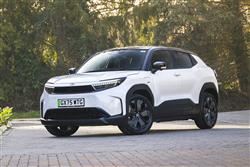
Toyota's first small EV crossover, the Urban Cruiser, should help the brand widen its appeal amongst those looking to go electric. It aims to combine fashion and practicality and, sure enough, seems to tick some trendy boxes.
Background word count: 213
Toyota doesn't seem completely comfortable with EVs in the way it is with Hybrids. It's been so slow in developing full-electric vehicles that it missed the 2024 UK ZEV mandate target by a full 15%. Even more surprisingly, by that point all three of the EV cars the company had bought us were created as part of joint projects led by other brands. Namely the bZ4X (engineered with Subaru) and the Proace Verso EV and Proace City Verso EV twins (engineered by Stellantis). True to form, the Urban Cruiser model we look at here was also created from a joint project. Toyota urgently needs smaller, more affordable EVs and this was the product of a joint venture with Suzuki, who developed their first electric vehicle, the e Vitara, from it. The Urban Cruiser shares all its engineering with that car and rolls down the same production line in India, a market where the Urban Cruiser name is used for a re-badged Suzuki Grand Vitara. Primarily though, the 'Urban Cruiser' nameplate is Toyota's. It launched on a trendy-looking model sold in Europe (including the UK) between 2009 and 2012, which was then replaced by a second generation design we didn't get. Now though, it's back for a new electric era. Let's take a look.
Driving Experience word count: 357
There's everything here you'd think the Urban Cruiser would need to make an impact in the compact EV crossover segment. So two battery packs, a proper bespoke electric vehicle platform and a choice of motor power outputs. Like most cars in this class, this one's front-driven, the line-up kicking off with a 49kWh battery pack energising a 142bhp motor with 189Nm of torque. Expect up to 214 miles of range. Ideally though, you'd stretch to the mid-level 61kWh model with its 172bhp motor - the car we tried; this won't feel much faster because it's torque figure is the same, but you'll be able to think in terms of around 265 miles of range - though this is still one of the lower figures in the class. 0-62mph takes 9.6s with the smaller battery - or 8.7s with the larger one - en route to the modest 93mph top speed all Urban Cruisers share. All of this is identical to what you get with the car this Toyota borrows all its engineering from, the Suzuki e Vitara, but unlike that model, there's no option here of a top twin motor AWD model. Across the line-up, you can maximise range figures by engaging stronger regenerative braking (with low, medium and high 'Regeneration Boost' settings via a centre screen button); but even the fiercest setting won't give you the kind of 'one-pedal'-style stopping power that you'd get with some class rivals. To maximise frugality, you'll obviously also have to activate the most frugal of the drive modes - 'Eco' (the others are 'Normal', 'Sport' and 'Snow'). On the move, refinement could be better - a combustion Yaris Cross Hybrid feels quieter - and the Suzuki-tuned chassis and suspension set-up delivers a soft ride, prioritised over sharp handling. But this car is in its element in town, thanks to light steering and a relatively tight 10.4-metre turning circle. On the highway, as with many electric cars, all the lack of an engine does is highlight wind noise and tyre roar. You won't be doing much towing in an Urban Cruiser - the braked towing figure is rated at just 750kg.
Pictures (High res disabled)
.jpg)
.jpg)
.jpg)
.jpg)
.jpg)
.jpg)
.jpg)
.jpg)
Scoring
Category: Compact Car
| Performance | |
| Handling | |
| Comfort | |
| Space | |
| Styling | |
| Build | |
| Value | |
| Equipment | |
| Economy | 60% |
| Depreciation | 60% |
| Insurance | 60% |
| Total | 63% |
Mobile
Narrow
Narrower
Normal
Wide