
A FEELING OF GLE (some text hidden) --NONE--
By Jonathan Crouch
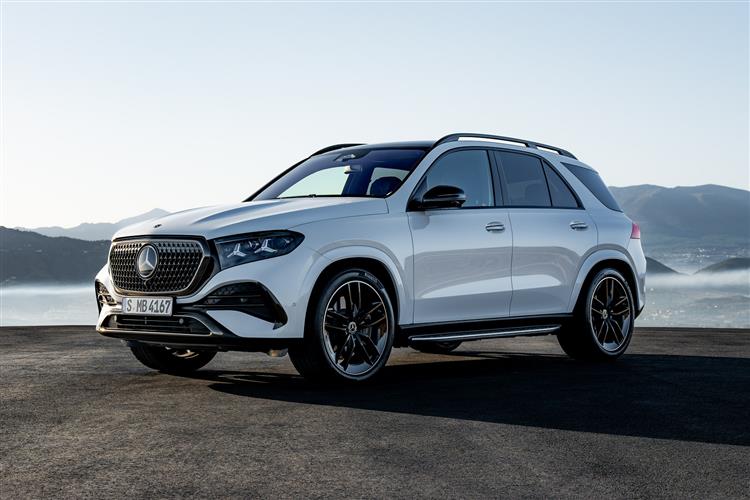
The Mercedes GLE is a large luxury SUV that's now gained a more dynamic look and a more sophisticated feel. Jonathan Crouch takes a look.
Ten Second Reviewword count: 89
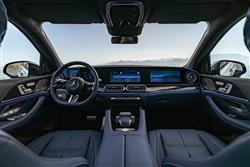
The Mercedes GLE is now a much stronger contender in the large model part of the luxury SUV segment thanks to more efficient engines and an almost completely new front-of-cabin design. Plus there are smarter looks for both the SUV and SUV Coupe body styles. The suspension can be more sophisticated too and there are greater levels of safety and media connectivity. As before, the GLE can in some forms seat up to seven. Rivals like BMW's X5 and Porsche's Cayenne must now take this car very seriously indeed.
Backgroundword count: 325
With all the EVs it's launching, Mercedes needs to make its combustion model life cycles last longer. And here's a case in point, its W167-era GLE large SUV, updated in Spring 2026 to create the car we're going to look at here, offered as before in both SUV and SUV Coupe forms. This model line's lineage dates back to 1997 and what Mercedes then called the M-Class, first launched as a W163-era design, then updated to the W164 model of 2005. Key changes came with the third generation W166-era model launched in 2011, which in 2015 got a change of name - from M-Class to GLE. At the same time, an alternative SUV body shape, the GLE Coupe, was introduced to sell alongside the standard SUV version. Those two body styles continued into this model line's W167-era fourth generation launched for the 2019 model year, with a light update along the way in 2023. This is the design which still continues today, albeit in this heavily updated form. Mercedes says that the updates made here are almost as extensive as would be required for a completely new generation design. As previously, this contender sits at the heart of the large model section of the luxury SUV segment, just above the brand's more compact GLC. And just below the much larger GLS. As you might be aware, cars in this GLE's class tend to fall into two categories in their approach to likely buyers. Seven-seat practicality is favoured by SUVs like Land Rover's Discovery, Audi's Q7 and Volvo's XC90 - which is one way to go. As an alternative, contenders like BMW's X5, Porsche's Cayenne and Volkswagen's Touareg give you only five seats but offer more dynamic looks and agile handling. As before, this GLE has the three-row seating of the first group - and aims for the handling agility of the second. That's as before. But let's take a closer look at what's changed here.
Engines and Tech Specword count: 455
There are no four cylinder GLE models any more (not for the UK anyway) - and you can't now have a diesel Plug-in Hybrid either. But core sales will still be of models that drink from the black pump, both in-line six cylinder 3.0-litre diesel units with 48V mild hybrid tech featuring an integrated starter generator. The base 350 d has 278hp, while the 450 d manages 367hp. Mercedes says both units have been made quieter and more efficient - and of course 4MATIC AWD and 9G-TRONIC 9-speed auto transmission continue to feature. As an alternative to a GLE diesel, there's now just a single petrol-powered Plug-in Hybrid, the six cylinder GLE 450 e. The main drive engine as part of this package is now the brand's updated M256 Evo' 3.0-litre turbo petrol straight six unit, which has gained a new cylinder head, larger intakes and new exhaust ports. A little surprisingly though, the PHEV system's 31.2kWh battery is basically the same, so the EV range figure isn't much different, rated at up to 65 miles. Total 450 e engine output is 443hp, which combines with a rear-mounted 178hp electric motor (47hp more powerful than the one in the previous model) for a total potent 569hp output, with 0-62mph achievable in just 4.5s. That's a big jump in output from the previous four cylinder GLE 400 e PHEV. If you want to go faster in a GLE, then as before, you'll need to stretch to the high performance Mercedes-AMG GLE 53, which has AMG-tuned adaptive suspension. As before, this can be had in a choice of two six cylinder petrol forms. Either as a MHEV mild hybrid, with 449hp (plus a further 23hp from the EV motor); or in PHEV 'HYBRID' form, with 449hp available (plus 184hp from the EV motor). With the 'HYBRID', that means a total output of 585hp with 750Nm of torque. Mild hybrid petrol tech is also used for the top 4.0-litre V8 Mercedes-AMG GLE 63 S 4MATIC+ flagship model. As with the previous version of this car, Mercedes offers a clever optional 48V E-ACTIVE BODY CONTROL system which combines with the optional AIRMATIC air suspension. With this, the spring and damping forces can be individually controlled at each wheel. This means that the system not only counteracts body roll, but also pitching and squat. Improvements made as part of this update see this set-up (via an online connection) able to store the location of big bumps and potholes - either ones you've encountered or surfaces encountered by other Mercedes models equipped with the system. The result it that if you then come across the bit of road in question, the E-ACTIVE system will prepare the suspension for that bump: clever.
To see the full road test text contact us on 0330 0020 227
Pictures (high res disabled)
.jpg)
|
.jpg)
|
.jpg)
| |||
.jpg)
|
.jpg)
|
.jpg)
| |||
.jpg)
|
|
Statistics (subset of data only)
Min |
Max |
|
Price: |
£80,000.00 (At 17 Apr 2026, SUV) |
£150,000.00 (At 17 Apr 2026, est) |
CO2 (g/km): |
195 (GLE 350d) |
|
Max Speed (mph): |
140 (GLE 450 e) |
|
0-62 mph (s): |
7.2 (GLE 450 e) |
|
Combined Mpg: |
31.8 (GLE 350d) |
|
Length (mm): |
4926 |
|
Width (mm): |
2015 |
|
Height (mm): |
1797 |
|
Boot Capacity (l): |
630 |
825 |