Mercedes-Benz S-Class - ABC Leasing
FIRST CHOICE SALOON(some text hidden)
By Jonathan Crouch
Ten Second Review word count: 55
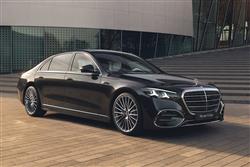
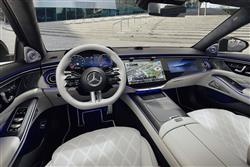
You're looking here at arguably the most advanced motor car Mercedes-Benz has ever built. No longer is an S-Class merely about comfort, refinement and performance. This improved version of the MK7 model also prioritises digitalisation and offers further steps forward in electrification and connectivity. There's never been a boardroom level luxury saloon quite like it.
Background word count: 214
The Mercedes S-Class. It's traditionally been the sensible answer to the question every motoring expert likes to dodge - 'what's the best car in the world?'. Other vehicles can be more opulent, faster or better to drive but over the years, no other model has so consistently delivered such a technologically-advanced blend of automotive virtues. The seventh generation W223-series version of this model line was first introduced back in 2020, but here we're looking at the heavily updated version of that design, announced in early 2026. It's a bit more than a facelift. No previous S-Class has ever been as complex, advanced or sophisticated as this one and Mercedes claims that over 2,700 components (around half of the car) have been 'newly developed or re-engineered'. In fact, the Stuttgart brand claims that this is its most extensive mid-life refresh ever. The exterior changes are subtle, but the front-of-cabin experience is very different and all the powertrains are significantly upgraded. There's still no full-electric option because of course that segment of the market is covered by the brand's EQS. The result of all of this is a more sophisticated 'Sonderklasse' model than any we've seen since the 'S' badging was first introduced in the original 'W116'-series model back in 1972. Let's take a closer look.
Driving Experience word count: 365
As before, UK S-Class sales are primarily built around six cylinder power and all the engines available now use either mild hybrid or Plug-in Hybrid technology, always mated to 4MATIC 4WD. The mild hybrid choice is between 375bhp S 450 and 443bhp S 500 petrol variants, both with an 'overboost' function that summon 640Nm of torque to help with short-notice overtakes. The alternative conventional engine option is still diesel, with a choice of the 308bhp S 350 d and the 362bhp S 450 d. There's no pure electric driving capability with the mild hybrids. For that of course, you'll need one of the two Plug-in Hybrid variants, both of which use a six cylinder petrol engine upgraded from the pre-facelift model. Choose between the 429bhp S 450 e with EQ Technology; or the top S 580 e with EQ Hybrid Technology, which has 577bhp (a useful 74bhp more than before). In both cases, the powerplant is mated to an electric motor energised by a 22kWh battery allowing for up to 73 miles of pure electric range (a few miles more than before). We should briefly mention what you can't have engine-wise in a UK S-Class; namely the all new flat-plane-crank V8 4.0-litre petrol engine with 530bhp fitted to the S 580 4MATIC variant that won't be sold here. You can though expect 4.0-litre V8 power to continue with the sporting Mercedes-AMG S 63 model. For other global market S-Classes, there's also a 6.0-litre twin turbo petrol V12, but for us that's limited to the Mercedes-Maybach S-Class line-up. Air suspension is standard-fit across the line-up and can be had with an optional 'active' system. Both setups work with a new 'Intelligent damper Control' system which uses data collected from the few other Mercedes models currently fitted with the same technology. The idea is to allow your S-Class to better anticipate potholes, speed bumps and road imperfections before you reach them. Rear-wheel steering's now standard too - or at least the base version of that system is, which turns the rear wheels by up to 4.5-degrees through the bends. Customers can upgrade to 10-degree rear steering, which takes almost 2 metres out of the car's turning circle.
Pictures (High res disabled)
.jpg)
.jpg)
.jpg)
.jpg)
.jpg)
.jpg)
.jpg)
.jpg)
.jpg)
Scoring
Category: Compact Car
| Performance | |
| Handling | |
| Comfort | |
| Space | |
| Styling | |
| Build | |
| Value | |
| Equipment | |
| Economy | 70% |
| Depreciation | 70% |
| Insurance | 70% |
| Total | 72% |
Mobile
Narrow
Narrower
Normal
Wide