Toyota RAV4
Call for best rate
.jpg)
.jpg)
.jpg)
This in an example leasing company site, powered by Car and Driving
Toyota RAV4
2.0 TDI SE Business 5dr
6+47 8k Miles p/a
Monthly payments: Call for best rate
Per month, excl VAT
CALL ME BACK
2.0 TDI SE Business 5dr
6+47 8k Miles p/a
Monthly payments: Call for best rate
Per month, excl VAT
What's this model like?
View an independent guide to buying this type of car below
The Definitive Review - Toyota RAV4
HOW TO RIGHT A BEST SELLER
Toyota's RAV4 tries to reinvent itself in sixth generation form. Jonathan Crouch takes a look.
The sixth generation RAV4 has been reinvented by Toyota for a new era - but not beyond recognition. There are sharper looks and a much more sophisticated cabin. But it now comes only as a Plug-in Hybrid - though a considerably more sophisticated one. Will it all make the RAV4 once again a mid-sized SUV to be reckoned with?
Background
New model launches don't come much more significant than when they concern the third best-selling car in the world. That's what Toyota's RAV4 is globally, a model line success story for this Japanese maker that stretches right back over three decades, since when RAV4s have found over 15 million customers worldwide. The first generation model of 1994 redefined what a compact SUV ought to be, pioneering a car-like monocoque body instead of the clunky ladder-framed platform construction then common in the segment. The second generation design of 2000 and MK3 of 2005 moved the RAV4 into the mid-sized SUV sector, while the MK4 version of 2013 introduced Hybrid power to that segment. Petrol / electric drivetrains were standardised by the MK5 version of 2019, which also gained a PHEV variant. Which brings us to this sixth generation design, announced in mid-2025. It gets a sharper look, a much more advanced cabin and a stronger PHEV drivetrain - now mandatory. Plus it's new Arene software development platform allows it to be what Toyota calls 'a software-defined vehicle', which allows safety and tech systems to be more easily updated over the ownership period. Sounds promising.
Engines and Tech Spec
For the UK, this MK6 RAV4 is now exclusively a Plug-in Hybrid. Other markets can also have it with this model line's usual non-plug-in full-Hybrid powertrain but at present, there's no sign of that being offered here. The PHEV drivetrain is basically the same 2.5-litre four cylinder unit as before, but now, for the first time, it can be had in two guises. The affordable variants serve it up in front-driven form (with 272bhp) but if you've more to spend and want top trim, you can have it in 305bhp AWD guise. Both variants now use a larger 22.7kWh battery (up from 18.1kWh) boosting EV range hugely to as much as 85 miles with the front-driven model (up from 46 miles). It's up to 75 miles with the AWD version, which uses three electric motors, the usual one on the front axle, plus one at the rear and one in the CVT transmission. Brake regen can be adjusted using steering wheel paddleshifters via six settings. 0-62mph takes 7.5s in the FWD version; or 5.8s in the AWD variant. Toyota says drive dynamics on all models will be enhanced by the way that the battery pack is mounted under the floor of the cabin (like an EV), rather than being slung out over the rear axle. This benefits weight distribution, centre of gravity and structural rigidity. Does that matter? After all, not since the original MK1 RAV4 of 1994 have we had a version of this car that's genuinely interesting to drive. And it would have been unrealistic to expect Toyota to replicate that little original three-door model's infectious joie de vivre in a car that these days is a much larger and heavier thing aimed at an older demographic. But, given that the previous MK5 model had all the driving involvement of a domestic appliance, there was certainly a need for a little R&D development here to match now-sharper looks. Those few RAV4 customers who care about such things will be directed to the top 'GR Sport' version, which gets high performance dampers, retuned springs, strengthened rear bracing, revised power steering and 20mm-more wheel track width.
Design and Build
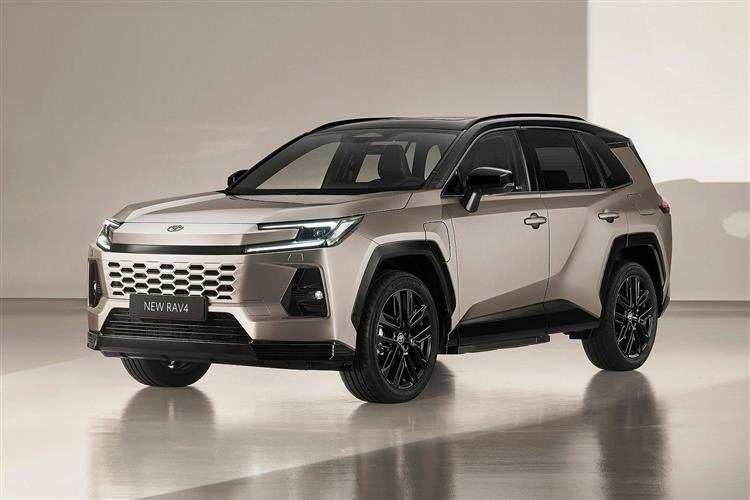
Not since the first generation model of 1994 have we had a truly distinctive-looking RAV4, but this sixth generation design might be it. Everywhere you look, there are sharper, more angular, more aggressive lines and the new 'hammerhead-style' front and rear lights bring the styling into line with the design language seen on recently introduced models like the Prius and the C-HR+. Particularly unusual is the undulating swage line that flows down from high in the D-pillar to the bottom of the front wheel arch. This MK6 RAV4 measures in at 4,617mm long, 1,879mm wide and 1,686mm tall and is larger in every direction than its predecessor. Finishing touches include chunky squared-off wheel arches that house either 18 or 20-inch rims. Plus there's a black 'RAV4'-branded trim strip between the rear lights and above base spec there's a contrast-coloured roof. Where change was really needed though, was inside and, sure enough, the cabin's been completely redesigned. It's still quite different from anything you'd find elsewhere and you wouldn't mistake the interior for that of a premium brand model - but Toyota has the Lexus NX to deliver that in this segment. Instead, the design focuses on user-friendliness and technology, aided by the adoption of the brand's new Arene operating system, which has bought with it a 12.9-inch central touchscreen more advanced than anything we've previously seen in a Toyota. Everything about that media set-up is better - the menus, the navigation and the over-the-air updates, all as part of what the brand calls an 'in-car digital environment'. And the voice control is far cleverer, able for instance not only to program navigation instructions but also to open the windows and change whatever media source you're listening to. The voice system can additionally be used for adjusting cabin temperature, though there are also physical buttons under the centre screen for doing that. Instrumentation is provided by a separate 12.3-inch combimeter. As before, the RAV4 remains a five-seater with decent rear seat space. There's no sliding bench though and the situation of the battery beneath the rear floor means a seated rear passenger's knees might be situated a little higher than they might like. On the plus side, there's considerably more boot capacity this time round, which in the PHEV version equates to 672-litres of total luggage room, far more than most PHEV rivals.