
BRIGHT SPARK (some text hidden) --NONE--
By Jonathan Crouch
The Range Rover Electric delivers the EV revolution to this plutocratic model line. Jonathan Crouch takes a look.
Ten Second Reviewword count: 39
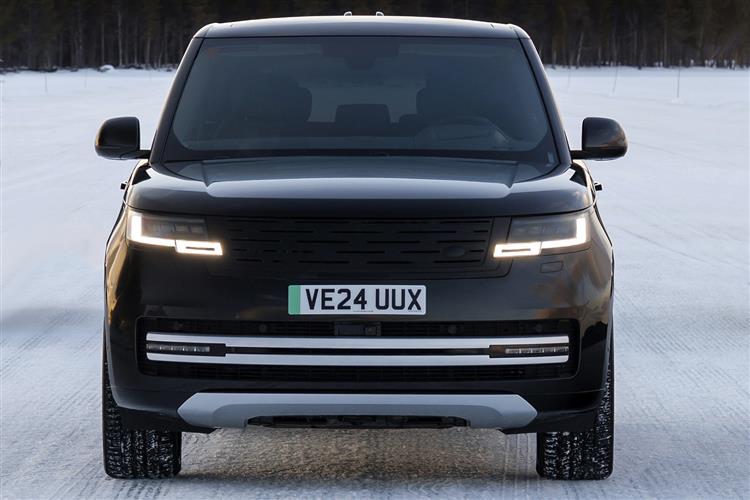
We waited a long time for the Range Rover Electric. And some will judge this model's lengthy development as time well spent. It's not the most advanced luxury EV we've seen, but it might just be the ultimate one.
Backgroundword count: 129
Has over half a century of Range Rover development led to this, the Range Rover Electric? That's what Land Rover wants to tell us. This is the brand's very first full-electric car and the first JLR EV since the Jaguar I-PACE of 2018. And it required the Solihull maker's biggest ever test and development programme for a single combustion system. It's a big deal. The company though, is keen to stress that customers need only choose this full-battery variant if their needs dictate that they should. It's not there to replace any existing mild hybrid or PHEV combustion derivative. Nor does it run on architecture wholly designed for an EV. Nevertheless, it might very well be the world's ultimate electric luxury SUV. For now. Let's take a closer look.
Engines and Tech Specword count: 536
You'd expect a very sophisticated EV powertrain from the self-proclaimed 'best 4x4xfar'. At first glance, you might wonder whether that's actually served up here. For sure, 542bhp and 850Nm of torque is a meaty output total, but then it needs to be to pull along over 2.8-tonnes of Solihull real estate. And that output is generated by only two motors (one on each axle) energised by a 118kWh battery pack. To give you some class perspective, the Range Rover Electric's closest rival, the Mercedes G 580 with EQ Technology, has a similarly-sized 116kWh battery pack, but puts out 579bhp via four motors. Land Rover considered more power and more motors for this EV Range Rover, but that would have hurt battery mileage and added weight - which would have required an even bigger battery, which would have added even more weight. The package as it is delivers a range of around 310 miles (a fraction more than that Mercedes rival). And there's certainly more than enough performance; the 0-62mph time of around 4.5s (again, similar to a G 580) is about the same as that of high performance V8 Range Rover SV. The kerb weight by the way, is only about 100kg heavier than a combustion Range Rover PHEV (which is supposed to make up to 75 miles between charges). Compared to other Range Rovers, there are some key engineering differences with the Electric version. The suspension for a start - still air-sprung but using the twin-chamber system from the Range Rover Sport, whose adaptive damping tech apparently allows closer body movement control. Another key difference is that with the EV, the centre of gravity is 60mm lower, which makes unnecessary the active anti-roll bars of the combustion models (and apparently improves ride quality). What is shared with the combustion model is the brand's four-wheel steering system, which makes this big car surprisingly easy to manoeuvre in tight spaces. There's brake regen control course. Pull back on the gear selector and instead of activating Sport mode, you enable virtually single-pedal driving. It's not all good news though. The 3.5-tonne braked towing weight of the standard model drops substantially in this EV to 2.5-tonnes. And ground clearance is down from 290 to 260mm. Which might make you wonder if this model line's legendary off-road ability has been compromised. Land Rover claims the opposite is true, pointing out that the EV drivetrain's power delivery is more controllable than with a combustion engine (no need to build revs). And the Integrated Traction Management software responds 100 times quicker than a mechanical system. The ordinary model's 900mm wading depth is unaffected by the ride height change and the battery is well protected from potential bashes from passing rocks. The breakover angle isn't as good as the standard model (down from 27 to 23-degrees); but you can still stop, then start again on a 35-degree incline. And the Terrain Response system is the same as with any other Range Rover, adjusting drivetrain, suspension, brakes and ride height according to modes set for drive conditions like snow, boulders or sand. There's also the usual Adaptive Off-Road Cruise Control system that'll ease you serenely over gnarly tracks with your feet off the pedals.
To see the full road test text contact us on 0330 0020 227
Pictures (high res disabled)
.jpg)
|
.jpg)
|
.jpg)
| |||
.jpg)
|
.jpg)
|
.jpg)
| |||
|
Statistics (subset of data only)
Min |
Max |
|
Price: |
£150,000.00 (At 2 Apr 2026, est) |
£180,000.00 (At 2 Apr 2026, est) |
Insurance group 1-50: |
50 |
|
Max Speed (mph): |
162 |
|
0-62 mph (s): |
6.8 |
|
Electric WLTP-Rated Driving Range (miles): |
310 |
|
Length (mm): |
5252 |
|
Width (mm): |
2209 |
|
Height (mm): |
1870 |
|
Boot Capacity (l): |
725 |
2601 |